
Resolve Product Availability's Problem
Date: 02.2024 - 12.2024
My Role: Continuous Discovery Process & Crafted Solutions
As a UX Lead at Navigate, I identified product availability problems through comprehensive research method.
41% of users unable to find desired products online or in-store.
48% of store visitors in NL researching products online before visiting.
Frustration during user testing when selected sizes were unavailable on product detail pages.
To tackle these challenges, I developed solutions and defined a clear scope through a continuous discovery process, driving CVR uplift.


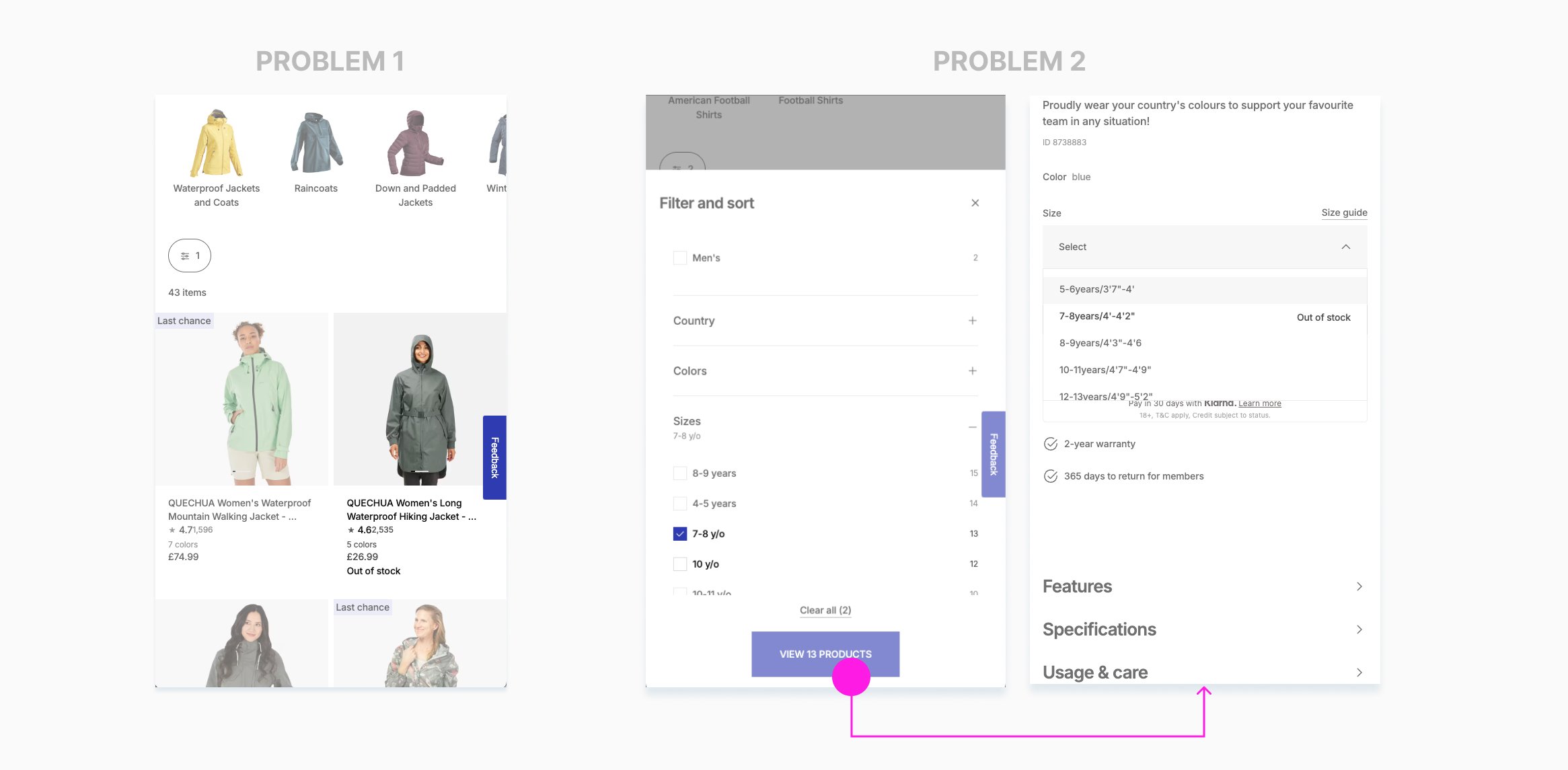
“The site keeps showing me out of stock products and inaccurate size availability. It’s frustrating to filter for my size only to find it’s actually unavailable on the product page.”
— Anonymous user from UK
The Goal of the Project
Maximize CVR to 3% on PLP and SERP by prioritizing products based on real-time online, in-store, and SKU availability to ensure users see the most accessible items first.


Design Process
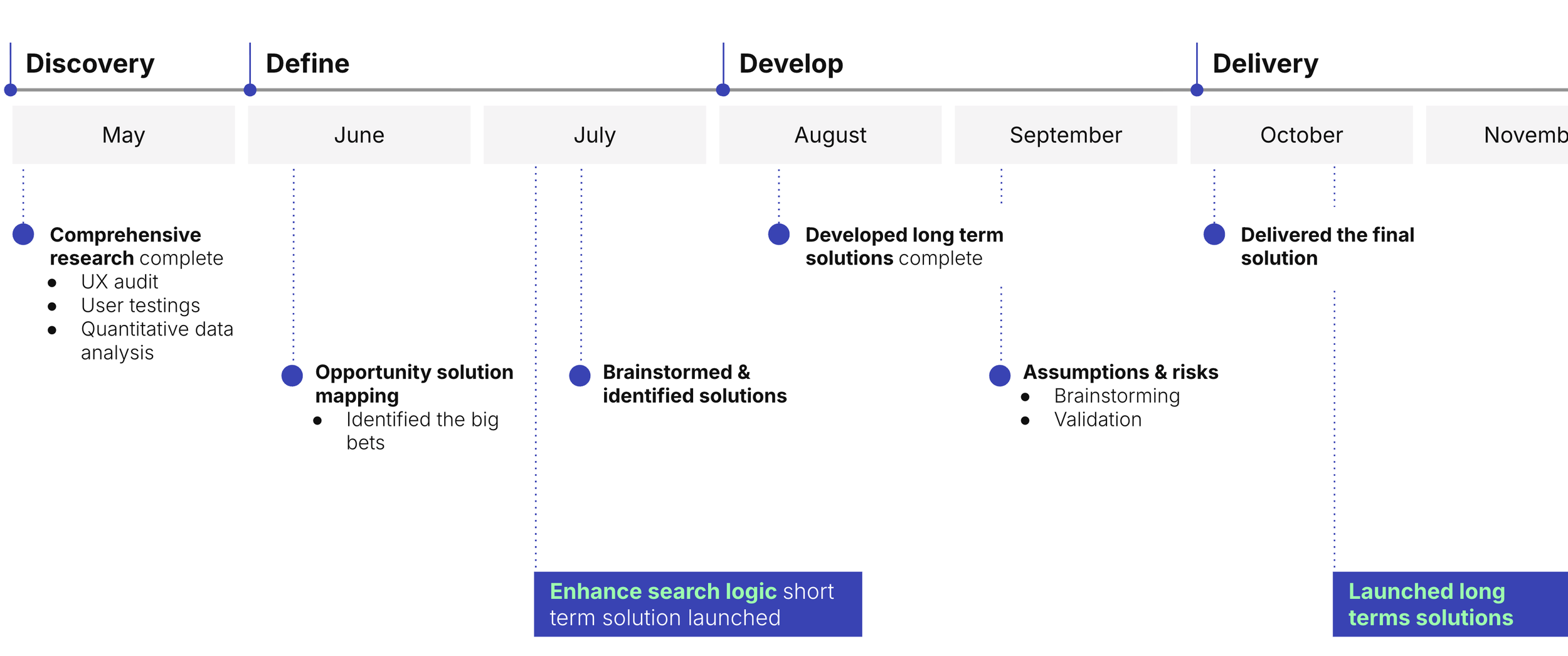
01. Comprehensive Research
The primary purpose of comprehensive UX research is to create a deep understanding of user experiences and to identify problems, leading to informed design decisions that enhance overall user satisfaction and business success. Through this research, we can effectively identify the most pressing frustrations, creating products that not only meet but exceed user expectations.
UX Audit (Heuristic evaluation & Usability check)
Moderate User Testings
Medalia Data & Shop Survey Analysis
01.1 UX Audit
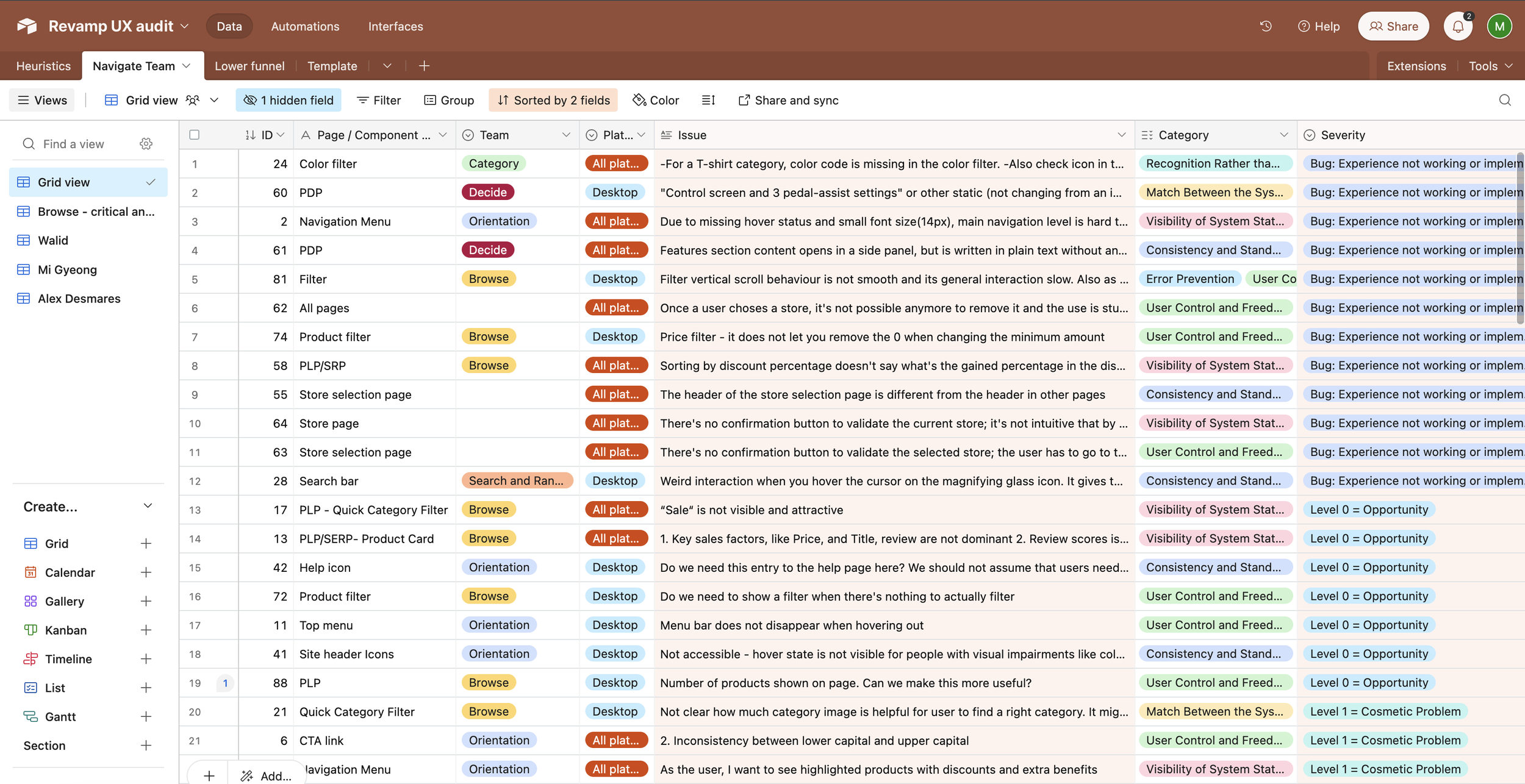
To guide the Decathlon Revamp, I led a UX audit with a researcher and content designer with using heuristic evaluations and a custom severity rating system. This systematic approach allowed us to focus our efforts on the most critical user experience challenges.
Through a comprehensive audit, we identified 65 usability issues and categorized them by the custom severity rating system that we built together:
8 Critical: Product Availability
High-severity blockers directly decreasing CVR.
15 Major: Filters
Moderate issues that can lead to a decrease of CVR
18 Minor: Accessibility
Can lead to a minor decrease in CVR
01.2 Conducted & Moderated User Testings
Understand user’s interaction & mindsets in different product categories
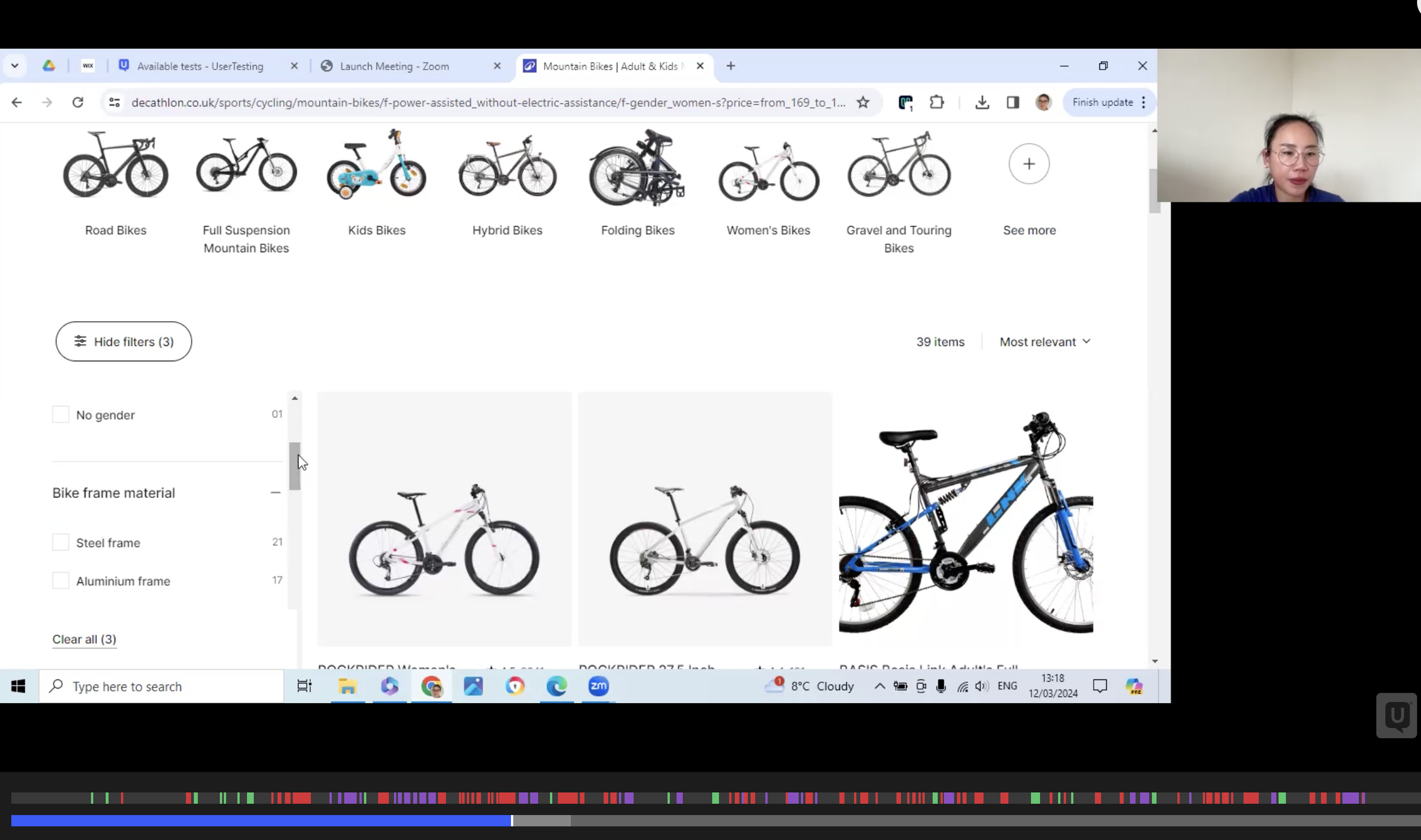
We conducted usability testing with 16 participants across two scenarios: searching for a low-stake 'football t-shirt' (mobile) and a high-stake mountain bike (desktop).
By testing different price points and devices, we identified critical friction points, including broken filters, inaccurate availability, and poor category logic, which we then synthesized into a comprehensive Experience Map
The Outcome of the Comprehensive Research
Through research, we identified key issues affecting both users and the business: product availability, accessibility, category navigation, and inaccurate search and filters.
Working with the Product and Engineering Managers, we prioritized these using the RICE framework (Reach, Impact, Confidence, Effort).
We concluded that product availability was selected as the top priority.
02. Quick Win Solution
Enhancing Search Flow for Better Product Availability
To address the issue of product availability, I proposed updating the ranking score for our search flow. Instead of prioritizing stock levels, we increased the weight of the "Availability Rate" from 3 to 7 of 80 points . This adjustment aimed to present the most readily available products to our customers.
The results were significant: through A/B testing, we achieved an additional €2.2 million euro in revenue and a 0.6% increase in the buyer rate.
03. Set up Regular Discovery Sessions
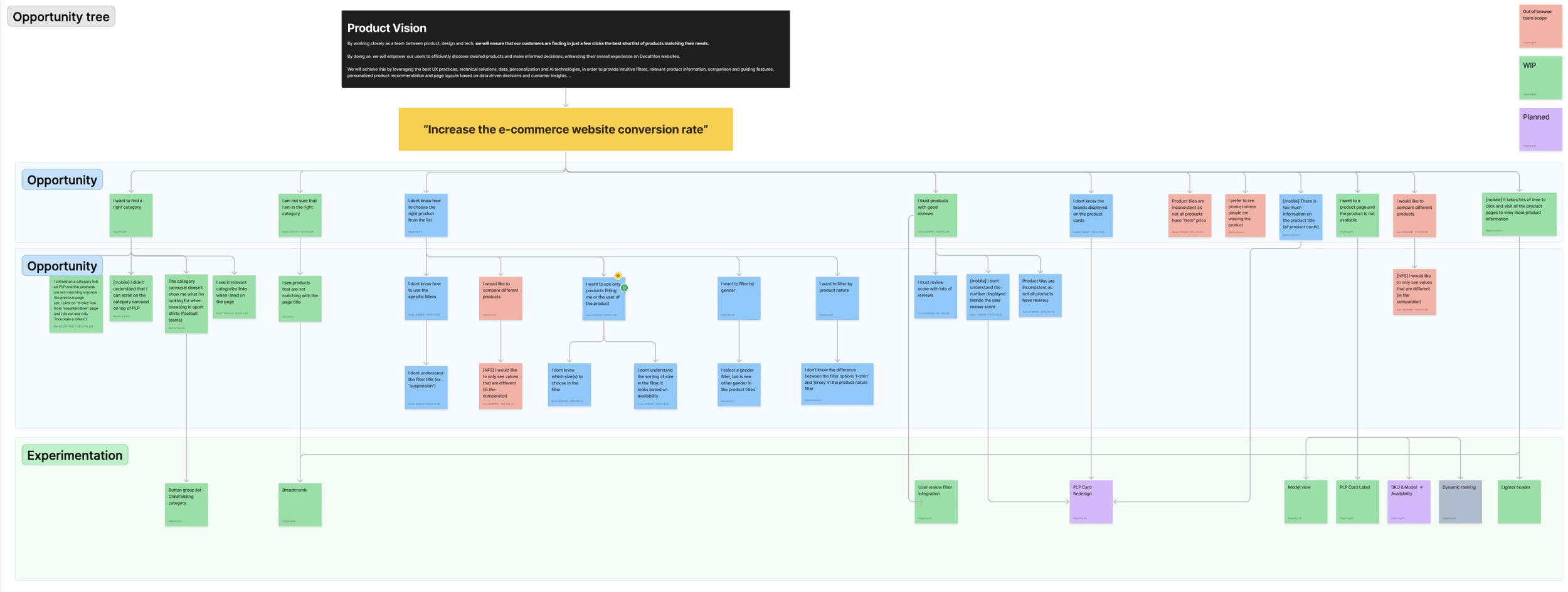
Inspired by “Continuous Discovery Habits” by Teresa Torres, I led a structured discovery process within our team, conducting weekly sessions over several months. These cross-functional meetings were key in identifying opportunities, uncovering problems, brainstorming solutions, and defining experimentation strategies, ensuring our product decisions were informed by continuous insights.
One significant opportunity identified was product availability. After evaluating various problems using the RICE scoring model, it became a top priority. Consequently, we decided to focus on this area in Q3.
03.1 Identify User’s Problems
In our discovery sessions, we kicked off by reviewing a research wall that synthesized a journey map, Medallia data, user testing, and technical insights. This comprehensive review allowed me to pinpoint critical user pain points and lead the team through a collaborative brainstorming session.
Through this process, we identified a major friction point in product availability: users frequently encountered out-of-stock items after applying specific filters (like color and size), leading to wasted time and effort.
HMW prevent users from encountering out-of-stock products after they’ve applied size and color filters, ensuring a more efficient and frictionless shopping experience?
03.2 Define Key Solutions
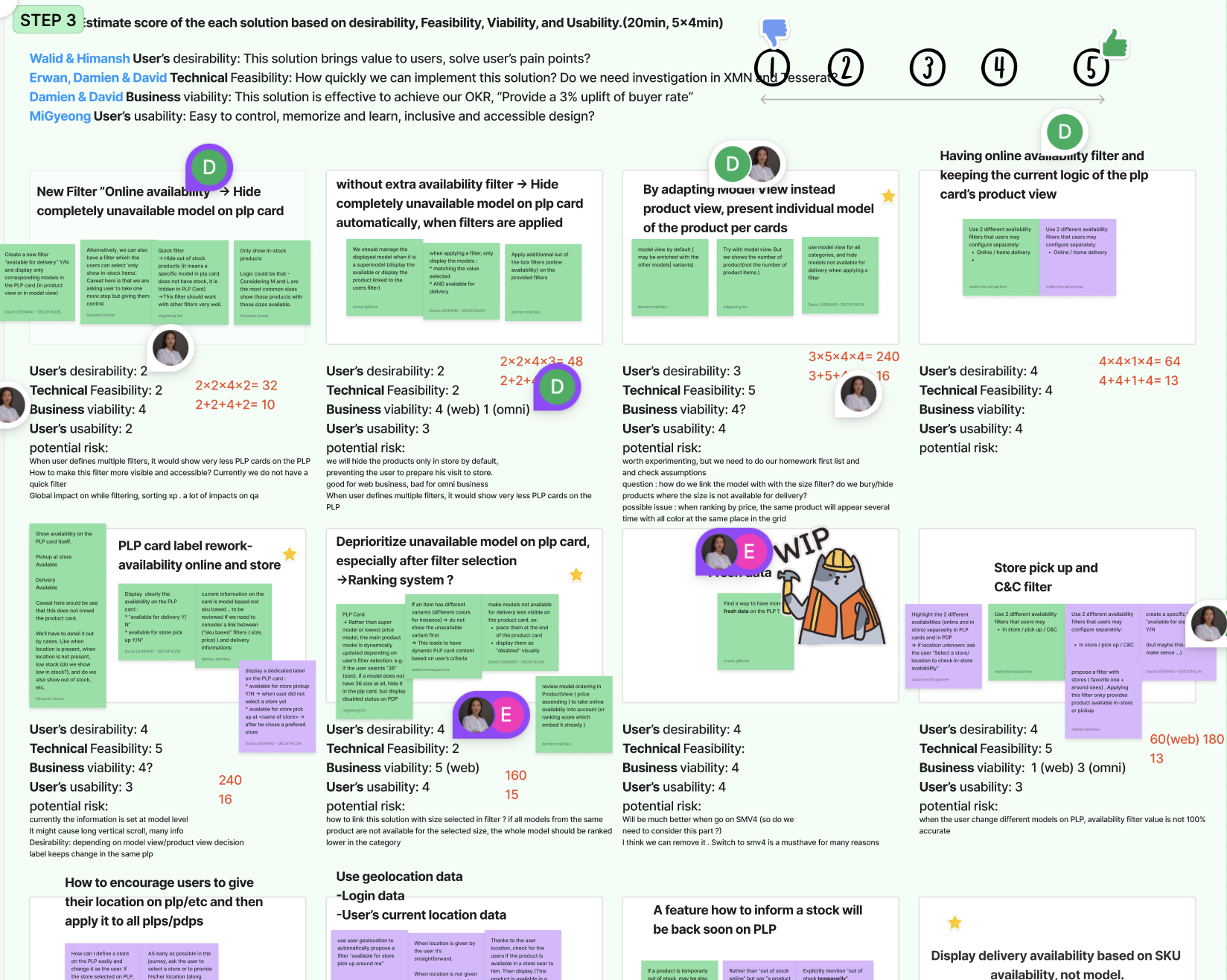
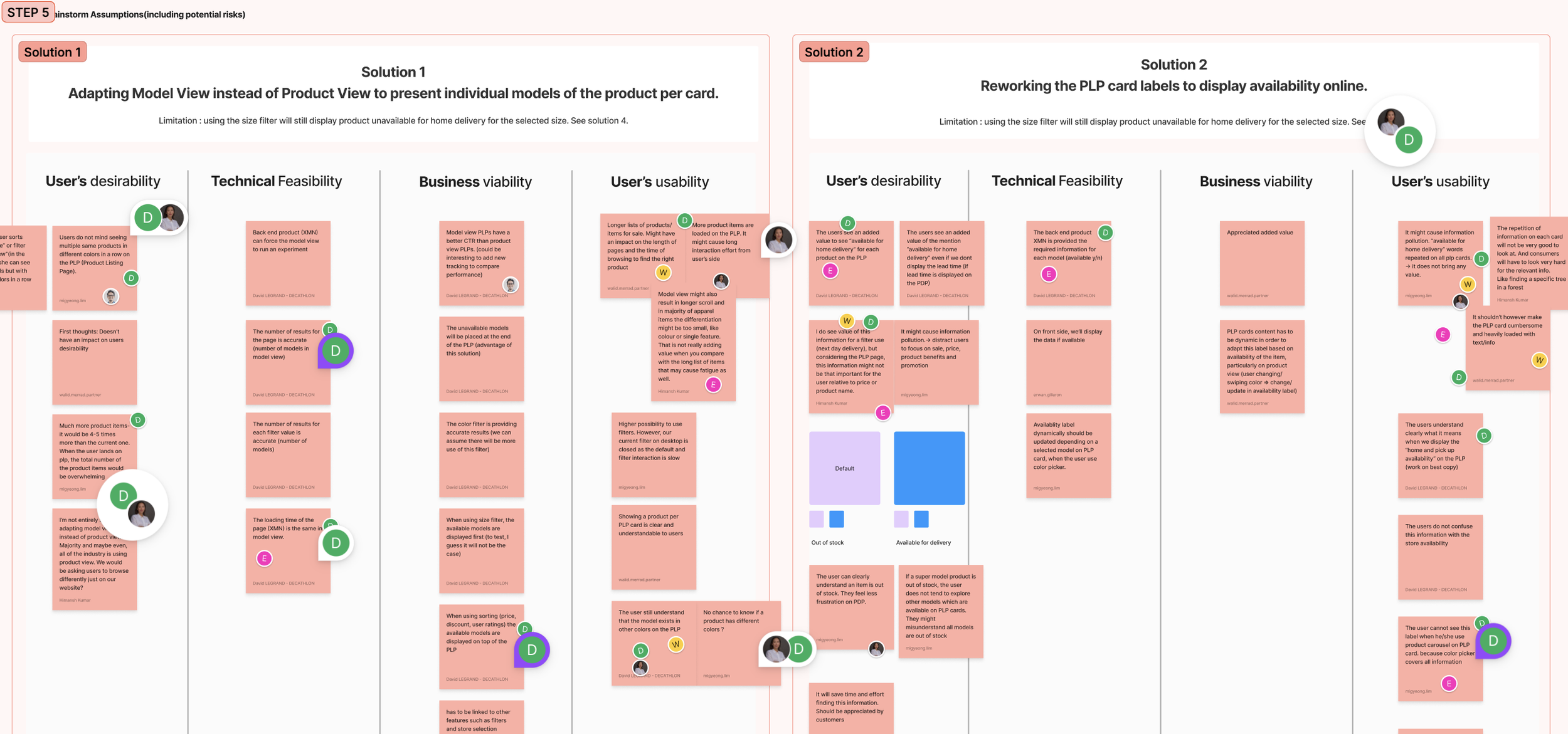
I organized and facilitated a collaborative workshop to brainstorm and evaluate potential solutions. We scored each idea against a standard Desirability, Feasibility, Viability, and Usability framework. After identifying potential risks, we prioritized four high-impact solutions and mapped their underlying assumptions.
Reworking the PLP card labels to display availability online and store.
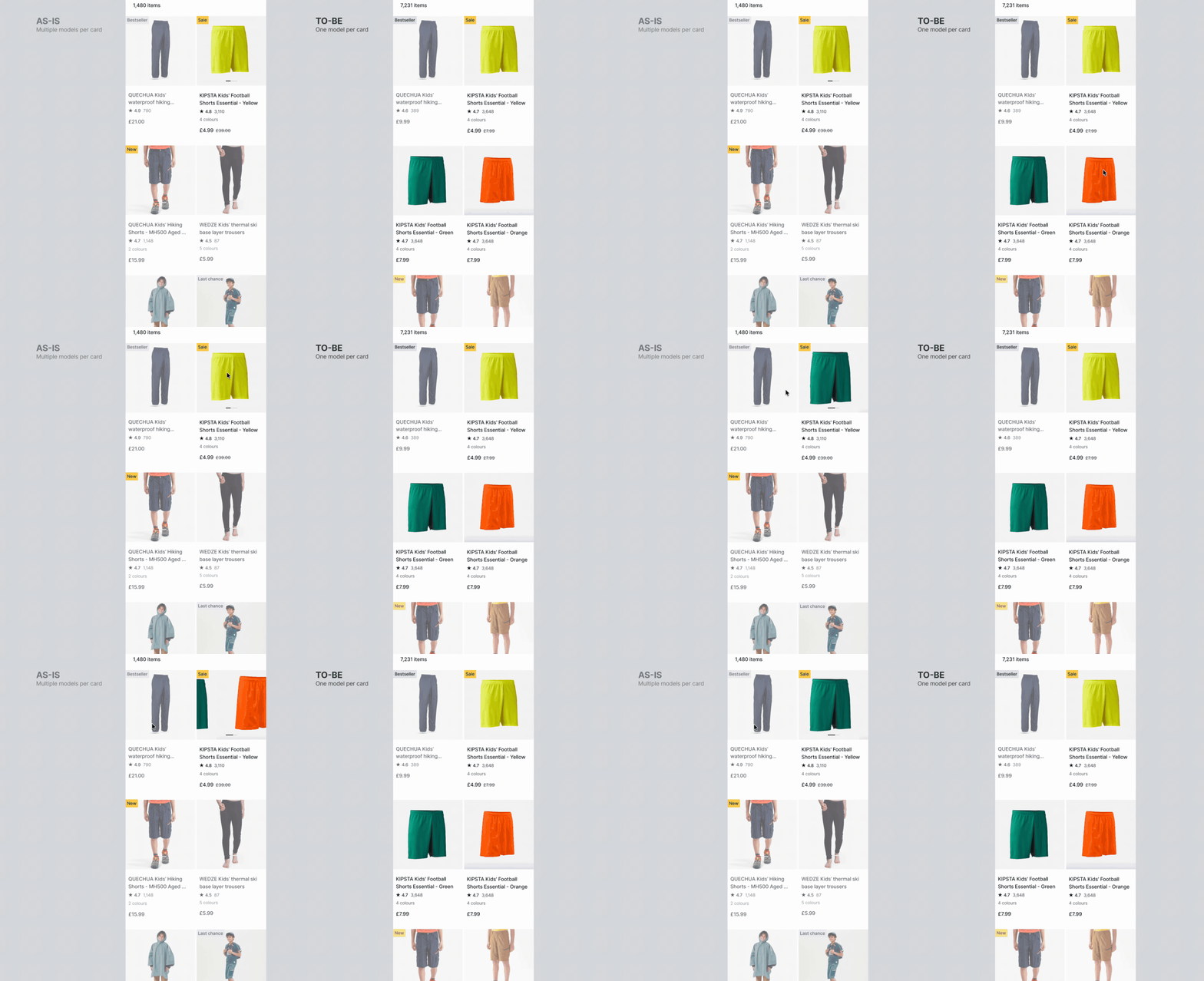
Product Card: Adapting Model View instead of Product View to present individual models of the product per card.
Implementing dynamic ranking on the PLP card to deprioritize unavailable models especially after filter selection.
Display delivery availability based on SKU (size) availability and model. So we display accurate info when size filter is applied.
In the final step, we focused on addressing potential risks, conducting four tests/surveys and one benchmarking study. This process allowed us to finalize our solution by mitigating identified risks.
I led this step to make a consensus of the assumptions, scheduled testing timings, build prototypes, and helped UX researchers to complete testing surveys.
03.3 Brainstorm Assumptions Focusing on Risks
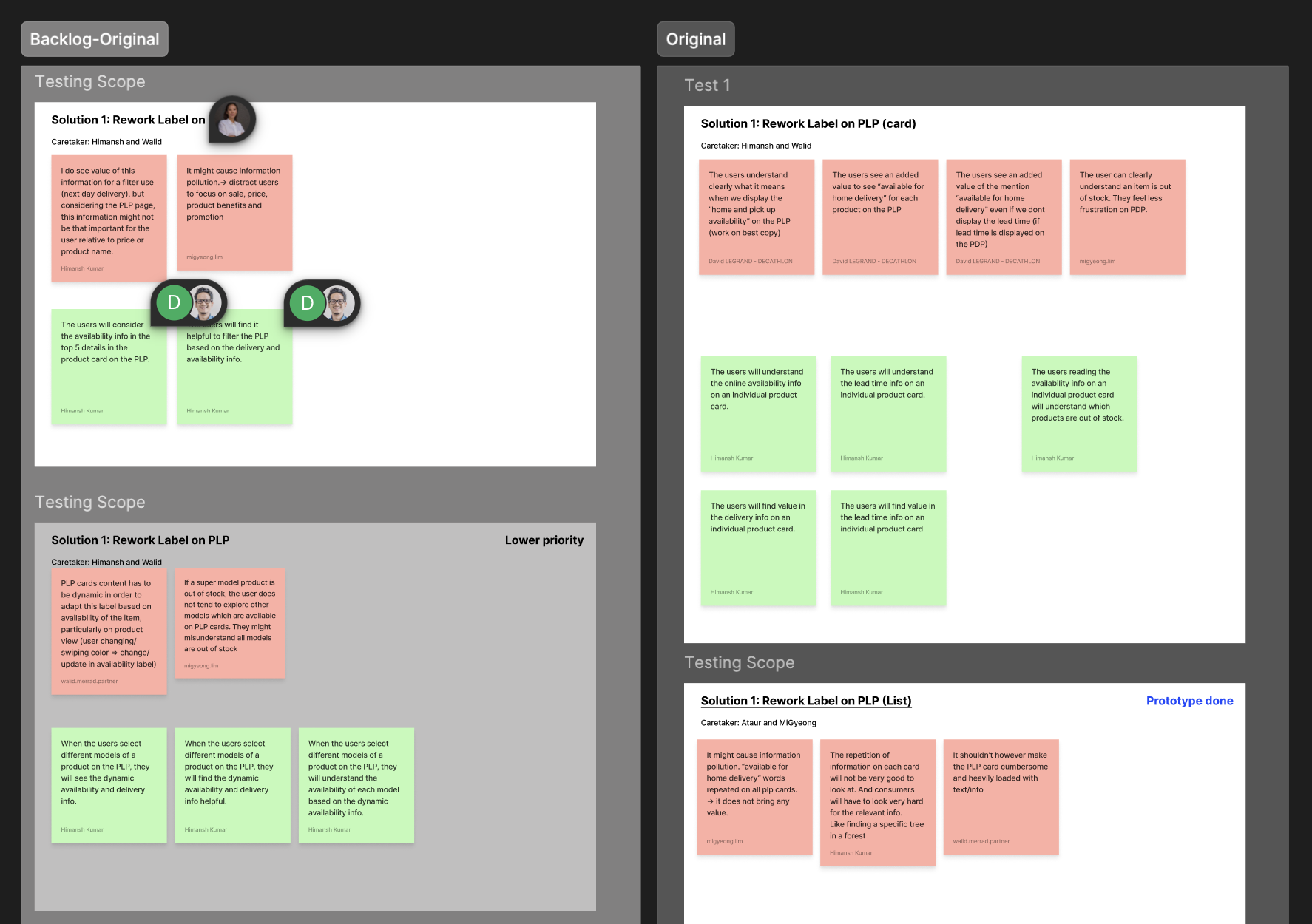
03.4 Test Assumptions to Reduce Risks in Solutions
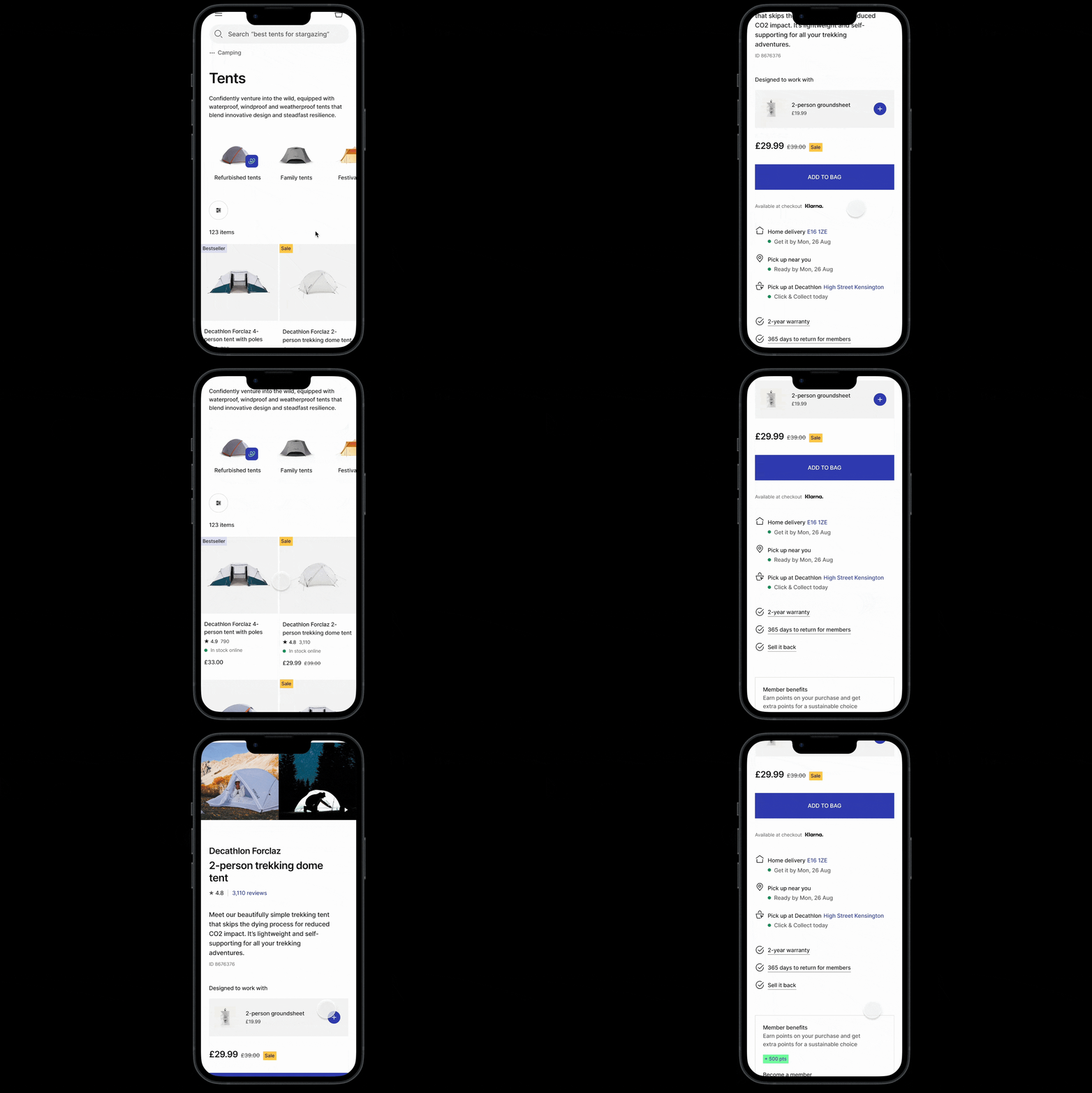
[Solution 1] Adding the PLP card labels to display product availability online
Three different labels: “In stock for delivery”, “Available for Delivery“ and “In stock online“ help user understand availability.
The user find the online availability info valuable.
The user can differentiate online availability from store availability.
The users will feel comfortable about the amount of info on each product card on the PLP.
Key takeaways
Users prioritize transparency: 80% of users prefer seeing both availability and unavailability statuses directly on the PLP.
[Solution 2] Adapting Model View instead of Product View
Users prefer seeing individual product models
The users will find it helpful to see multiple cards of the same product on PLP when they sort or fliters.
When we show multiple cards(colors) of each product, the user will understand that the product exists in multiple colors.
The expanded list view feels manageable.
Key takeaways
During the test, most users(8 out of 10) did not notice any difference between the model view and the product view.
When exposed to both prototypes, all participants preferred the product view.
According to benchmarking, Product view is used more than model view on ecomm sites.
According to Content square, a Color indicator in Product view PLP Cards present low user’s engagement
In addition, unlike our current product view, many ecomm sites display different models in the same product multiple times.
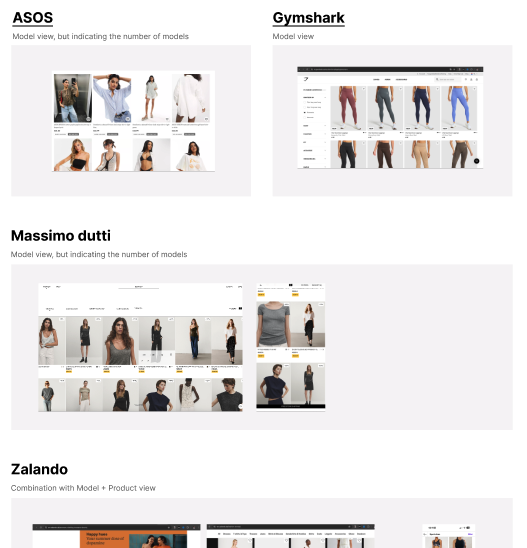
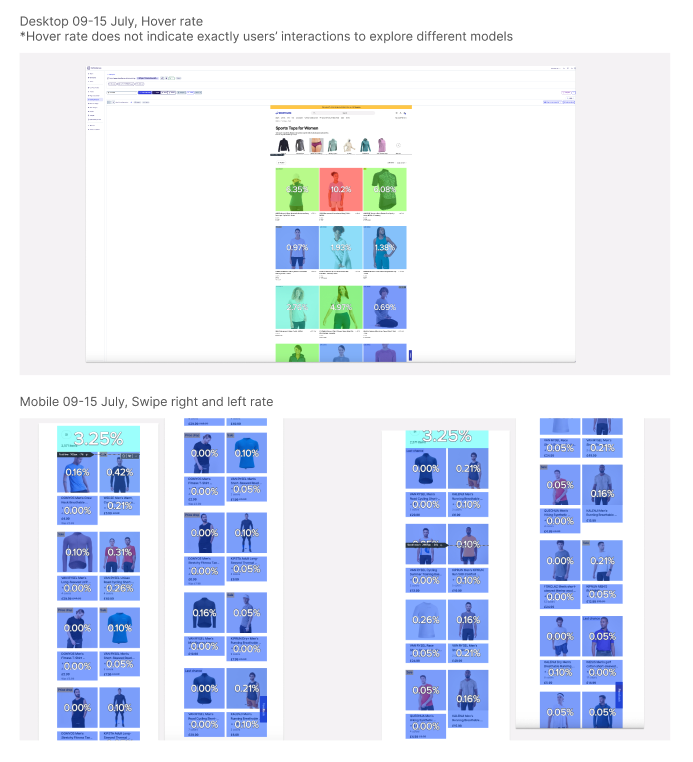
To reduce the risks associated with a model view, I also conducted benchmarking across ecomm products. A Content square analysis focused on user tap, swipe, and hover interactions within existing product views.
Key takeaways
Many ecomm sites, especially single-brand stores, favor product-based views over model-based views on the PLP by repeating the same product across different models.
Contentsquare data shows low user engagement with image carouselsto explore different models.
Conclusion of Testing Assumptions
Through validation testing and user surveys, I gained valuable insights into how different users interpret product availability across various labels. This helped me identify design opportunities and optimize user experience. For instance, I was able to mitigate risks by adjusting elements like the number of models displayed on the product listing page cards.
04. Long Term Solutions
Solution 1 : Integrating a Product Availability label on PLP Card
0.68%
CVR uplift
We conducted three A/B tests for three different solutions:
Integrating a Product Availability label on PLP Card
Adopting a Model view to the PLP Card
Displaying Available Products based on SKU & Model
Each test lasted for ca 6 weeks, and the results showed successful performance.
0.53%
1P Add to cart uplift
4,30M€
Business value
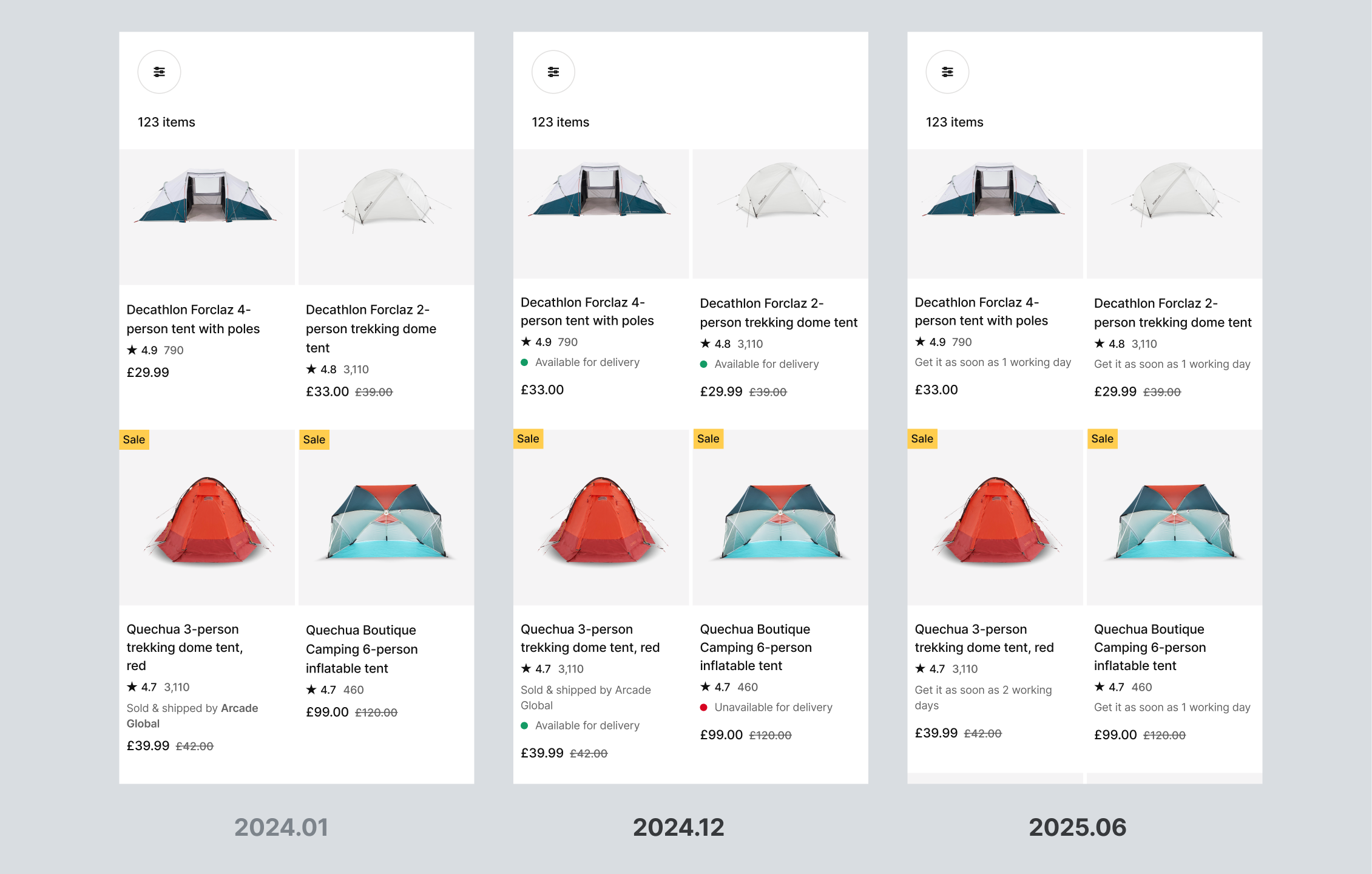
Solution 2 : Adopting a Model view to the PLP Card in PLP & SERP
1.13%
CVR uplift
1%
Add to cart uplift
11,74M€
Business value